All posts by Todd's Time

FAA Aand P testing

Federal exams is now

A&P FASTRACK INC

(3)
Aviation training institute in Bethany, Oklahoma ? Open

Thumbnail Image


§ 65.77 Experience requirements.

Each applicant for a mechanic certificate or rating must present either—

(a) An authenticated document from a certificated aviation maintenance technician school in accordance with § 147.21 of this chapter; or

(b) Documentary evidence, satisfactory to the Administrator, of—

(1) At least 18 months of practical experience with the procedures, practices, materials, tools, machine tools, and equipment generally used in constructing, maintaining, or altering airframes or powerplants, appropriate to the rating sought; or

(2) At least 30 months of practical experience concurrently performing the duties appropriate to both the airframe and powerplant ratings.

[Docket FAA-2021-0237, Amdt. 65-63, 87 FR 31415, May 24


-?———–


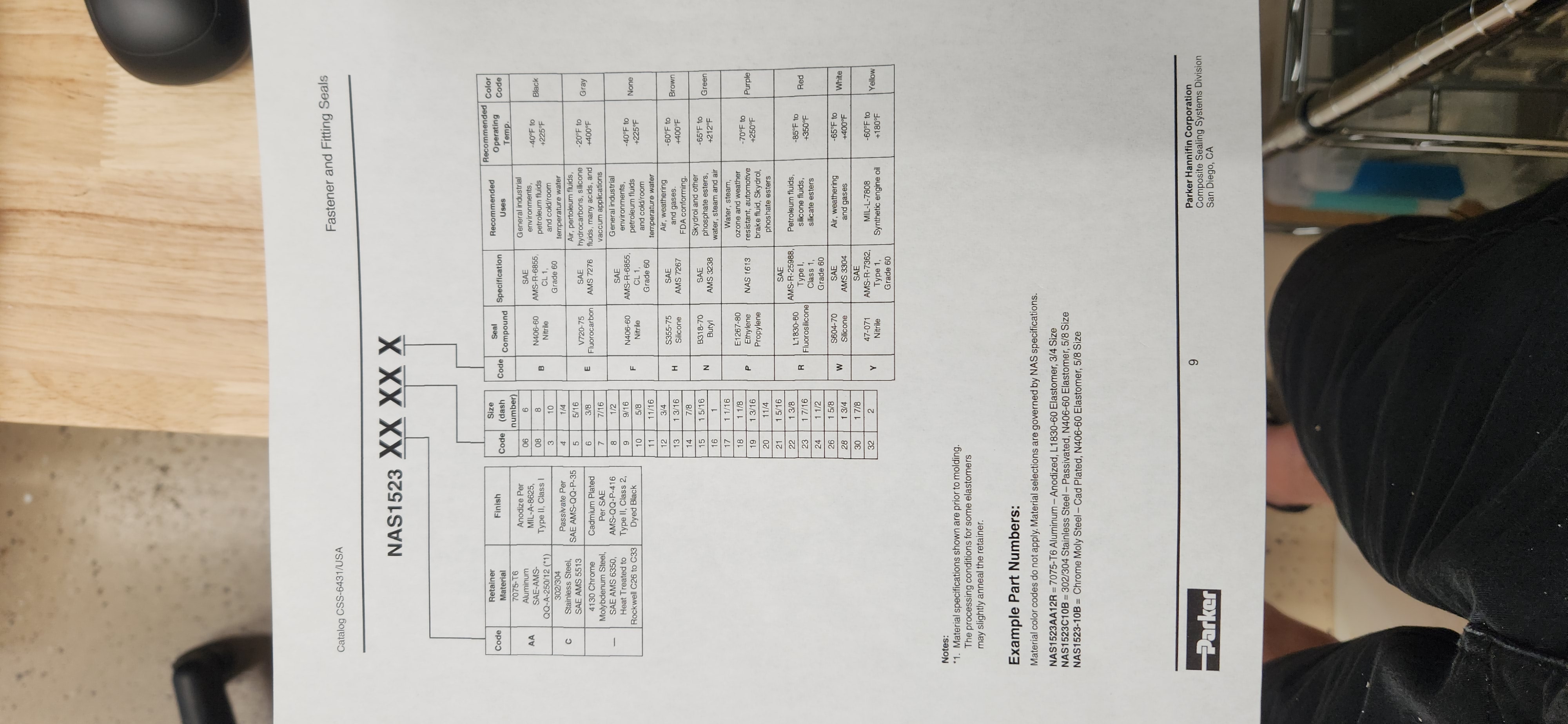
statoseal stat-o-seal

https://ph.parker.com/us/en/product-list/600-series-stat-o-seal

ms28775-008


600-0102-10 number 10 nitril

600-3130-10 O/S florocarbon

600-0742-10 Chromemoly neoprene


Old pn 600-0000-10


?  Still available?


https://www.zatkoff.com/parts/stat-o-seals/stat-o-seal-nitrile-600-0000-10


L-39. To TFE 731


Todd,

I likely do not qualify as having too much money but I could use a
conversation and perhaps some aid in a project I’m working on.

Specifically, I had an itch to do something “jet” a few years back.  I
looked at buying a bud’s PC-12 or sticking a PT-6 on a Lancair.  Neither
really turned my crank.  I thought the L-39 was interesting so I did some
training towards my type.  I was ready to sit my ride and decided there
was no need as the thing is a bit of a dog and I could not see myself
owning one.

A few months later, I was exposed to AV’s L-139 project where they built a
few planes with 731-4s for a US trainer bid.  That spurred some thought
about doing a -3 variant along with pulling out all that old Russian crap
like wiring, avionics and ejection seats.

Fast forward 18 or so months and I rolled out on the runway with a L-39
that went from 7250 lb empty to 6000 lbs and had a nearly timed out -3 off
the back of a WestWind.  First flight and the plane was off in a 1/3rd of
the runway instead of 2/3rds, stalled at 68 IAS dirty (instead of over 90)
and handled rather well.  Development on that project continues and
several planes are in the process of conversion.

My development mule went on the airshow circuit to build some time and abuse-
https://youtu.be/b0bDzJkhUJg?t=27

I brought on an ole timer in the jet maintenance world when it became
clear that my hobby needed some “depth in the field” which I did not have.
He has deep contacts within the maintenance community.  We’ve collected
-3s from WestWinds and Hawkers as the planes have fallen out of service.
Along the way we found a F20-5 with a very nice pair of BRs.  The records
had been stolen but I was able to recreate them via Duncan (for one motor
that was just out of MPI/CZI) and the European shop that did the other
motor.  That is good enough for the experimental world.

We are completing our second bird now which will be used to demo the -3
concept.  I’m turning my attentions to finishing the -5BR project and am
currently doing N1 DEEC homework.  You were kind enough to post the SB for
the N1 DEEC installation which was terribly helpful.

I got lucky with the -3 in that I pulled my first motors from a WestWind
along with harnesses and N1 DEECs.  The WW is the only bird with 731s that
I know of that does not use APR (too cheap I guess) so I did not have to
resolve the single engine what do you do about sync and APR issues.  That
is not the case on the -5BRs.  I have 800XP documentation on the wiring
but it uses separate sync and APR boxes.  I’m looking for F20-5 or other
wire prints that depict a single APR/Sync box in the N1 DEEC airframe side
harness (engine harness are unchanged).  It would also be nice to find
someone familiar with how the various functions work from a wiring
perspective.

Please let me know if you would be interested in helping out.

Best Regards,
Bill Hart
561.371.3700
bill@lolachampcar.com

Todd,

Thanks for checking in.

The -3 program is doing well and is well settled with over five hundred
hours over many different installations.  A good friend of mine has taken
up the task of building planes for customers.  His site is
www.East2WestAero.com.

The -5BR project was a hand full.  There were a couple of issues on the
DEEC wiring that caused some issues early on.  The APR test mode was
constantly enabled and the DEEC was always in air idle mode.  The result
was the darn thing wanted to taxi at 45 its!  I identified the version of
APR/Sync system that was used which let me combine some Honeywell and
Falcon documentation to better understand both issues.  I closed the loop
on the APR test circuit which reduced N2 at idle a good bit (increase in
N2 at idle is confirmation of APR functionality). I then simply strapped
ground/air to ground all the time which got the monster down to a
reasonable residual thrust.  However, the “always ground” prevented the
DEEC from recording flight statistics.  I looked at using a squat switch
but the plane simply did not want to land with air idle; it just kept
floating down the runway and I had to slip it to get it on the ground.  I
finally ended up adding the DEEC air/ground input to one of the MLG down
switches so I got ground idle with the gear down.  It has the added
benefit of making a gear up landing much harder as it really will not land
if the gear is up AND it has flight idle.  So, all good on that front.

The part the really kicked my butt for over a year and a half was the more
aggressive inlet diffuser required by the -5BR installation.  The motor is
longer (than the -3) so the diffuser is shorter.  In addition, the -5BR
has a larger diameter fan which adds even more the the angle of the
diffuser.  Flow detached and stalled basically shutting off the motor in a
millisecond.

After a bunch of different configurations I ended up using an old trick
that engine manufacturers use to slow the air and build static pressure
exiting the last compressor stage before the burner cans.  High speed air
blows out the flame in the burner can which is no good.  High speed air is
also lower pressure slow slowing the air increases pressure, thus
compression ratio and thus efficiency.

I finally got an intake design to work and boy is it a monster.
https://www.youtube.com/shorts/PW-Fp8JbN4c
On paper is has 33% more thrust.  As installed, raw runway acceleration is
about 20% better than our -3 so static thrust suffers from the small
inlets.  Once you get some ram air it seems to work even better.  I was
out with one of my customers, we both filled up and left the same field
within a minute of each other.  We climbed at similar power settings
(relative) and similar IAS.  I was passing through 15k has he passed
through 10k so the -5BR is a real monster.

Thanks much for the help.

Best Regards,
Bill

Show quoted text
———- Forwarded message ———
From: <bill@lolachampcar.com>
Show quoted text
Show quoted text


Which TFE 731 is used on which airframe


TFE731-3-1C FALCON 50
TFE731-3-1E 731 JETSTAR/L1329
TFE731-3-1F JETSTAR II/L1329
TFE731-3-1G WESTWIND 1124
TFE731-3-1H BAe HS125
TFE731-3-1K JETSTAR II/L1329
TFE731-3A-2B LEARJET 55
TFE731-3A-2B1 LEARJET 55
TFE731-3A-200G IAI ASTRA 1125
TFE731-3AR-200G IAI ASTRA 1125
TFE731-3AR-2B LEARJET 55
TFE731-3AR-2B1 LEARJET 55
TFE731-3AR-2B2 LEARJET 55
TFE731-3AR-3B LEARJET 55
TFE731-3AR-3B1 LEARJET 55
TFE731-3AR-3B2 LEARJET 55
TFE731-3B-100S CITATION III/CITATION VI
TFE731-3BR-100S CITATION III/CITATION VI
TFE731-3C-100S CITATION III/CITATION VI
TFE731-3C-200G IAI ASTRA 1125
TFE731-3C-3B LEARJET 55
TFE731-3C-3B1 LEARJET 55
TFE731-3CR-100S CITATION III/CITATION VI
TFE731-3CR-200G IAI ASTRA 1125
TFE731-3CR-3B LEARJET 55
TFE731-3CR-3B1 LEARJET 55
TFE731-3CR-3B2 LEARJET 55
TFE731-3D-1C FALCON 50
TFE731-3D-1G WESTWIND 1124
TFE731-3D-1H BAe HS125
TFE731-3D-1K JETSTAR II/L1329
TFE731-3DR-1D SABRELINER 65/65A
TFE731-3DR-1G WESTWIND 1124
TFE731-3DR-1H BAe HS125
TFE731-3R-1D SABRELINER 65/65A
TFE731-3R-1G WESTWIND 1124
TFE731-3R-1H BAe HS125

The Learjet 55 also used the TFE731-3 engine.


F900 Stab trim normal will not run in either direction

TL;DR  Turned out to be  bad stab jack, installed in the airplane for less than 2 years.


F900EX


customer reports he can hear the main relays click…  no up or down, no report on the autopilot.

Note, thus is the HStab jack that has internal normal limit switches.   The other stab jacks have external limit switches in 4 CF.


print PDF

PowerPoint print so that you can draw on it.  (LibreOffice Impress)

f900 stab trim


Common wire type in corporate jet


Single hook up wire:
M22759/style-guage-color

M22759/16-22-9 is a common white wire

deeper info

NOTE: 24 AWG wire is generally deprecated in most corporate jets.  It is just too delicate to stand the test of time

Color chart


Multi conductor:
M225700/guage   spec   conductors shield  outer,

now called AS22759

Thanks Spruce……

here is a Spruce page with basic multiconductor P/Ns

Much more detailed guide to multiconductor:

ACS-REF 24 M27500 WIRE AND CABLE PRODUCTS